
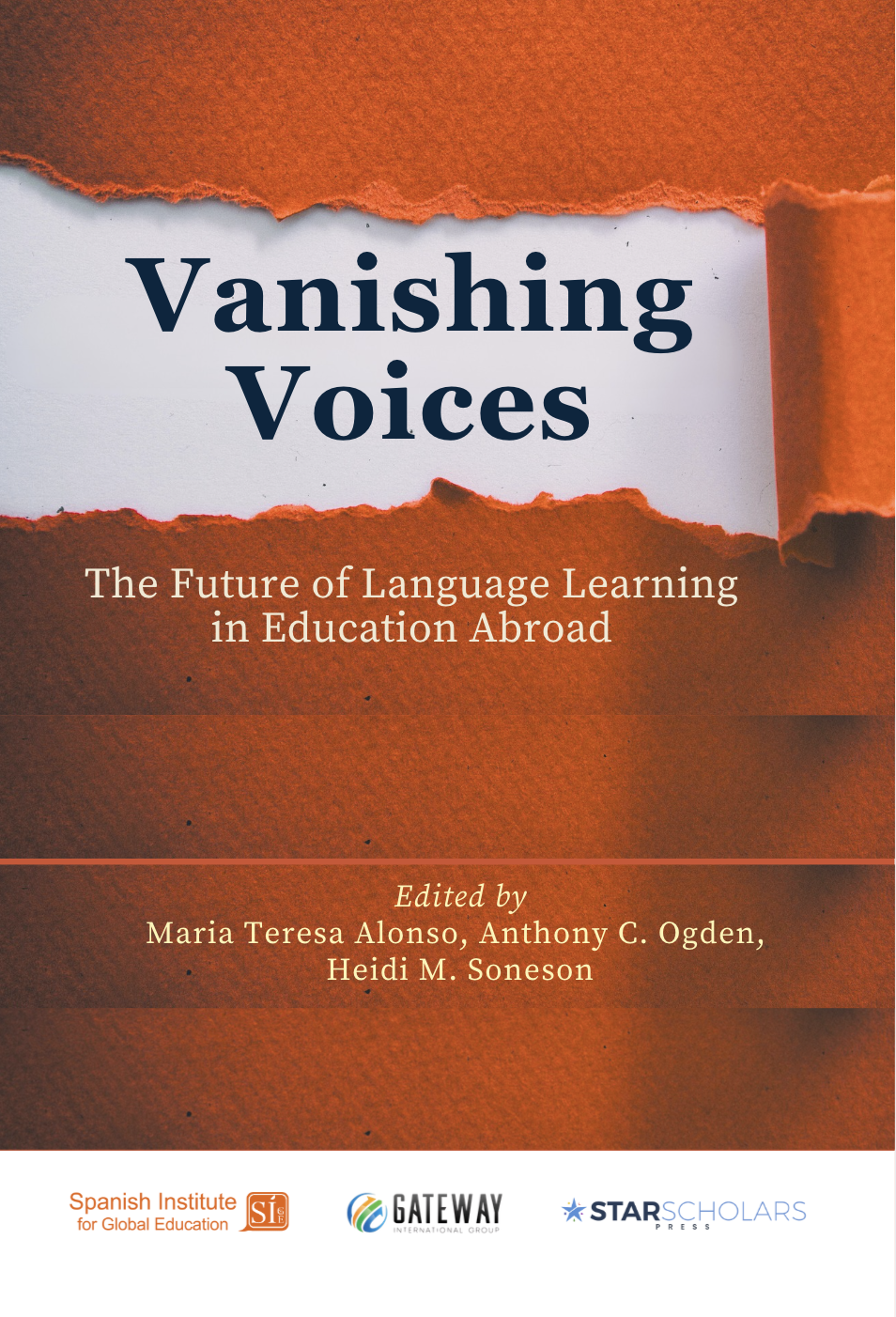
Vanishing Voices: The Future of Language Learning in Education Abroad
STAR SCHOLARS PRESS
Publication date :
June 30, 2026
Synopsis
━━━━━━━━━━━━━━━━━━━━
ORDER YOUR COPIES
Free Copies | Print or eBook | Amazon.es | Google Books
━━━━━━━━━━━━━━━━━━━━
Vanishing Voices: The Future of Language Learning in Education Abroad examines one of the most pressing questions facing international education today: What happens when students study abroad without learning the language of the communities that host them? As foreign language enrollments decline and education abroad increasingly shifts toward English-taught, short-term programming, this volume explores the implications for intercultural learning, student engagement, and global understanding. Drawing on research, professional practice, and lived experience, the contributors examine the historical, institutional, and technological forces reshaping language learning in education abroad.
Bringing together leading scholars and practitioners, Vanishing Voices explores the causes and consequences of declining language study, the opportunities and limitations of artificial intelligence, innovative approaches to program design, and the powerful ways language shapes identity, belonging, and intercultural understanding. Grounded in student stories, the volume argues that language remains far more than a tool for communication—it is a gateway to deeper cultural understanding, meaningful engagement, and transformative learning. Essential reading for international educators, faculty, administrators, and researchers, Vanishing Voices challenges readers to reconsider the role of language in preparing students to thrive in an increasingly interconnected world.
Editors
María Teresa Alonso, Ph.D., is the Founder and President of the Spanish Institute for Global Education, and she has been a professor of Anthropology at the University of Seville and Vice Dean of the School of Education at the Loyola Andalusia University. Her major research interests include language learning, teacher training, and innovative methodology.
Anthony C. Ogden, Ph.D., is the Founder and Managing Director of Gateway International Group, a consultancy specializing in international higher education. He is a respected educator with over 25 years of experience and has held senior leadership roles at Pennsylvania State University, the University of Kentucky, Michigan State University, and the University of Wyoming. With more than 60 publications, Dr. Ogden is also a prolific author whose work demonstrates his expertise and influence in international higher education.
Heidi M. Soneson, Ph.D., has worked in international education since 1983, holding leadership roles at the University of Wisconsin–River Falls and the University of Minnesota. She has led institution-wide initiatives in international student services and education abroad, served in leadership positions with NAFSA and The Forum on Education Abroad, and published extensively on education abroad policy and practice.
Table of Contents
Acknowledgements ..... i
The Pillars of Hercules ..... ii
Introduction of the Spanish Institute for Global Education ...... 1
Introduction Vanishing Voices: The Future of Language Learning in Education Abroad ..... 15
SECTION ONE Historical Foundations and Shifting Contexts of Language Learning
Engagement in Practice: Immersion, Independence, and Language Learning ..... 23
Chapter 1: Language Learning in U.S. Higher Education: Trends and Tensions ......27
Chapter 2: Language Learning in U.S. Education Abroad: Shifting Realities and Institutional Responses ....... 37
SECTION TWO Artificial Intelligence and Language Learning
Engagement in Practice: Technology, Mediation, and Language in an AI-Enabled World ..... 49
Chapter 3: The Introduction of AI and Its Broader Impact on Higher Education..... 53
Chapter 4: Harnessing AI to Enhance Language Learning: Vocabulary Acquisition, Pre-Departure Preparation, and In-Country Engagement.....63
SECTION THREE Program Modalities and Curricular Strategies for Language Integration
Engagement in Practice: Program Design, Structured Learning, and Language Integration ..... 77
Chapter 5: Integrating Language through Program Design and Curricular Innovation ...... 81
Chapter 6: Redesigning Advising, Orientation and Co-Curricular Learning .....95
SECTION FOUR Language and Identity in Education Abroad
Engagement in Practice: Identity, Belonging, and the Personal Dimensions of Language ...... 109
Chapter 7: Language, Power and the Dynamics of Belonging ..... 113
Chapter 8: Language, Emotion and Vulnerability of Learning Abroad ..... 123
Partnerships in Practice: Community Engagement and Internships ...... 135
Contributing Editors ..... 141
Contributing Authors ..... 142
Contributing Authors
David Becerra Alonso, Ph.D., is an Associate Professor at Universidad Loyola, Andalucía, Spain, and collaborates with the AYRNA research group at the University of Córdoba.
Carlos Aguasaco, Ph.D., is a Professor of Latin American Cultural Studies and Chair of the Department of Interdisciplinary Arts and Sciences of City College of the City University of New York (CUNY).
Giselda Beaudin, M.A., is the Executive Director of Global Initiatives at Rollins College, Winter Park, Florida.
Dan P. Dewey, Ph.D., is a Professor of Linguistics and Second Language Acquisition and Department Chair of Linguistics at Brigham Young University, Provo, Utah.
James Eckler, M.Arch, M.Sc., is a Professor of Architecture, Academic Vice President and Dean of Reap College of Creative and Professional Studies at Marywood University, Scranton, Pennsylvania.
Timothy Lynn Elliott, Ph.D., is the Director of the Office of International Study Programs at Brigham Young University in Provo, Utah.
Chrissie Faupel, Ph.D., is the Director of International Affairs at the University of Minnesota Duluth. An active member of NAFSA and AIEA, she contributes regularly to the advancement of the international education field.
Bethany Galipeau-Konate, MBA, D.Prof. is the Executive Director of Global Education at Shenandoah University in Winchester, Virginia.
Erin Hillis, Ph.D., is the Executive Director of the Buckman Center for Global Engagement and a senior international officer at Rhodes College in Memphis, Tennessee.
Christina Isabelli, Ph.D., is a Professor of Spanish Linguistics and Associate Provost for Global Engagement at Gonzaga University in Spokane, Washington.
Megan Jones, Ph.D., is the Director of the Center for Global Education at Drew University in Madison, New Jersey.
Dana Lindaman, Ph.D., is the Department Head of World Language and Cultures at the University of Minnesota Duluth and Associate Professor of French Studies.
Myriam Monterrubio is a certified English teacher and consultant in Seville, Spain. She is the co-author of five English-language series for kindergarten students and the creator of Talkies-Based Learning (TBL).
Kate Moore, Ed.D., is the Principal and Founder of the Global Career Center in Boston, Massachusetts. She authored the NAFSA book, Internships, Service-Learning and Research Abroad and was lead contributor for the chapter “Program Types: A Matrix for Cross-sectional Analysis” within Education Abroad: Bridging Scholarship and Practice.
Marcia Morgan, Ph.D., is Dean of Global Education and Professor of Philosophy at Muhlenberg College in Pennsylvania. She teaches courses on ethics, social-political thought, law and morality, and organizational leadership.
Mary Kate Naatus, Ph.D., is Associate Professor in the Department of Marketing in the Stillman School of Business, Dean of Continuing Education & Professional Studies, and Associate Provost for Partnerships & Global Initiatives at Seton Hall University in South Orange, New Jersey.
Jessica A. Quintana Hess, Ms.Ed., is the Assistant Dean of Global Initiatives & Programs at Marywood University in Scranton, Pennsylvania.
Sarita Rai, Ph.D., is the Director and a faculty member at the University of Hawaiʻi at Manoa (UHM) Study Abroad Center.
Jennifer Rathbun, Ph.D., is a poet and translator, Professor of Spanish, Chair of the Department of Modern Languages and Cultures, and Chair of the Department of Philosophy at Ball State University, in Muncie, Indiana.
Mary Alice Soriero, MS.Ed, is Director of Academic Affairs at the CEA CAPA Education Abroad, Seville, Spain Center and Adjunct Professor at Loyola University Andalucia.
Leah Spinosa De Vega, M.A. is the Executive Director of Global Initiatives at Augsburg University in Minneapolis, Minnesota. Her research interests include language and intercultural agility in therapeutic relationships.
Therese Tardio, Ph.D., is a Teaching Professor of Hispanic Studies and Director of the Humanities Scholars Program at Carnegie Mellon University in Pittsburgh, Pennsylvania.
Christina Marie Villarreal, Ph.D., is Director of University Partnerships and Development at the Spanish Institute for Global Education in Seville, Spain.
Downloads
Copyright
Copyright (c) 2026 STAR SCHOLARS PRESS
