Kayyali, M. (Ed.). (2026). Handbook of Higher Education, Volume 6: AI, Automation & Decision Intelligence (Vols. 6). STAR SCHOLARS PRESS. https://doi.org/10.32674/kwbpw840
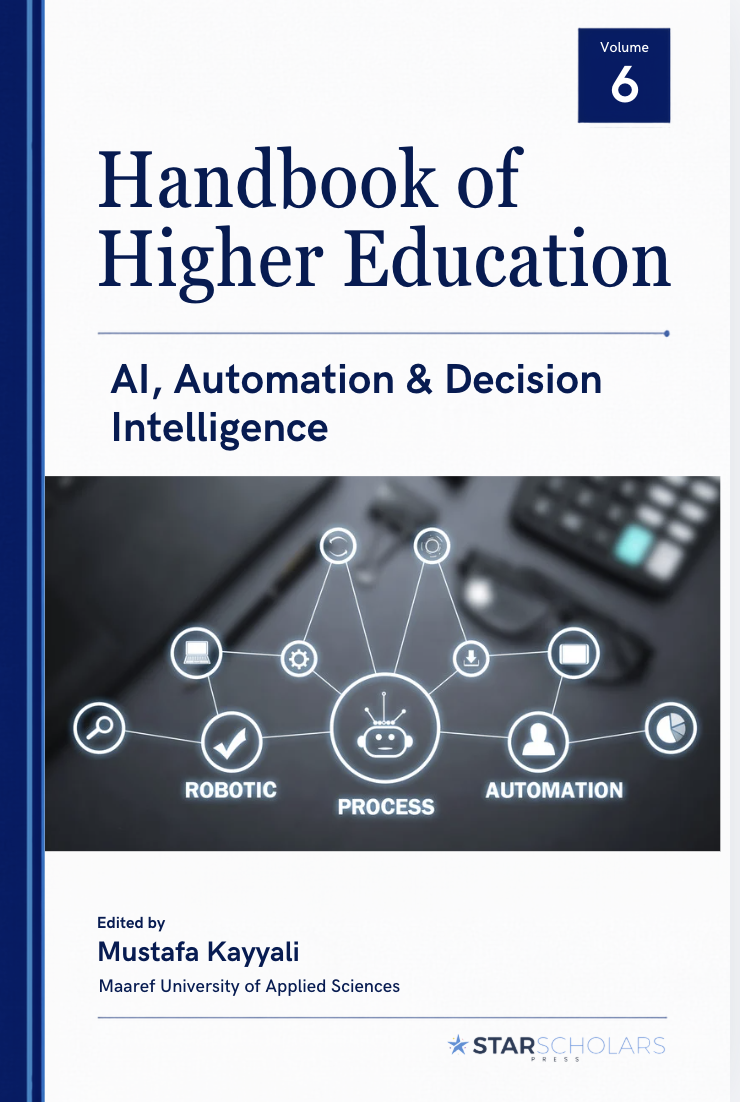
Handbook of Higher Education, Volume 6: AI, Automation & Decision Intelligence
STAR SCHOLARS PRESS
Publication date :
September 10, 2026
Synopsis
This volume examines how artificial intelligence, automation, blockchain, and data-informed governance are changing decision-making in higher education. Ten chapters move from academic credentials and learning records to educator roles in open and distance learning, university digital transformation strategies, faculty capability development, smart teaching governance, AI-supported teaching tools, disability inclusion, and digital-age policy. Contributions from multiple national and institutional contexts combine conceptual analysis, case comparison, technical architectures, and practical institutional recommendations. A central concern is how universities can use intelligent systems to improve efficiency, trust, access, and responsiveness while preserving professional judgment, transparency, privacy, and human responsibility. The volume treats faculty development and inclusion as essential parts of technological transformation rather than secondary implementation issues. Intended for researchers, university leaders, faculty developers, quality assurance professionals, policymakers, IT teams, and graduate students, it argues that decision intelligence becomes educationally valuable only when automation is governed ethically, interpreted critically, and aligned with institutional learning.
Editor: Mustafa Kayyali, Maaref University of Applied Sciences
How to cite this book: Kayyali, M. (Ed.). (2026). Handbook of higher education: Vol. 6 - AI, automation & decision intelligence. Star Scholars Press.
ISBN: 979-8-89524-101-1 (hardcover)
ISBN: 979-8-89524-102-8 (ebook)
Order Hardcover Book | Download eBook (Open Access)| Available on Amazon, Barnes & Noble, Google Books, and other vendors
List of Contributors
Rahul K. Patel, Illinois Institute of Technology, USA
Smrity Dey, JIS College of Engineering, India
Rakhi Dey, JIS College of Engineering, India
Zahra Sadat Roozafzai, University of Applied Science and Technology, Iran
Akiva La Geer-Jeremiah, Central China Normal University, China
Sherihan Radi, Brandenburg University of Technology, Germany
Vijaya Supriya Samnoel, REVA University, India
Pedzisai Goronga, University of Zimbabwe, Zimbabwe
Morine Matongo, University of Zimbabwe, Zimbabwe
Memory Deredzai, University of Zimbabwe, Zimbabwe
Parveen Sharma, Lovely Professional University, India
Yogesh Kumar Sharma, Lovely Professional University, India
Mustafa Kayyali, Maaref University of Applied Sciences, Syria
Restu Januarty Hamid, Bosowa University, Indonesia
Monika Vishwakarma, University of Lucknow, India
Maria Arjie T. Domingo, Bulacan Agricultural State College, Philippines
Carimo Hassam Rassal, University of Algarve / University of Évora, Portugal
Priti Dadasaheb Mane, Saibalaji International Institute of Management Sciences, India
Sarika Rajabhau Khandekar, D.Y. Patil Vidyapeeth, Global Business School and Research Centre, India
Downloads
Chapters
-
Blockchain for Academic Credentials and Learning Records
-
Redefining Educator RolesThe Impact of AI and Machine Learning on Teaching Practices in Open and Distance e-Learning (ODeL) Environments in Zimbabwe
-
Assessing Digital Transformation Strategies at UniversitiesThe Comparison of Two Cases in Kazakhstan and Implications for Higher Education Policy
-
Developing Digitally Savvy FacultyInstitutional Strategies for Sustainable Digital Transformation
-
The Faculty of the FutureRedefining Academic Roles in Digital Ecosystems
-
Governing Teaching and Learning in Smart Institutions
-
Role of AI-Driven Tools in Transforming Teaching-Learning in Higher Education
-
Digital Transformation in Higher EducationEnhancing Access and Inclusion for Students with Disabilities
-
Blockchain for Academic Credentials and Learning RecordsTechnical Architectures and Policy Implications for Smart Institutions
-
Redefining Higher Education in the Digital AgeTechnologies, Pedagogies, and Policy Perspectives
Copyright
Copyright (c) 2026 STAR SCHOLARS PRESS