
College Presidency Book Series
1 Titles
The Praxis of the College Presidency Series: Strategy, Practice, and Transformational Leadership
Series Editors:
Dr. Edward J. Valeau, President/CEO, Transformative Education Leadership Institute, National Center for the Study of Community College, Superintendent/President Emeritus, Hartnell Community College District,
Dr. Ding-Jo H. Currie, Director, Leadership Institute for Tomorrow, CSUF, Chancellor Emeritus, Coast Community College District
Series Description:
The Praxis of the College Presidency Series is a seven-volume series that illuminates the real work of leading colleges and universities, domestically and globally, through the combined wisdom of experienced presidents, chancellors, and emerging leaders. Building on the insight-rich narratives of Success as Destiny and From Insight to Impact, the series reveals how reflective practice, strategic thinking, visionary, courageous leadership advance institutional and student success in a time of profound transformation.
Each volume translates presidential principles into lived practice, drawing from authentic stories of navigating governance, equity, finance, enrollment, community engagement, and organizational change, to name a few. The series explores how leaders harness technology, data, AI, digital innovation, and entrepreneurial thinking to reimagine possibility, strengthen mission, and extend educational opportunity to all in a culturally pluralistic, dynamic society. It also underscores the essential role of global leadership practice, preparing today's executives to work effectively within an increasingly global and interdependent world.
Uniting presidential experience with the reflections of aspiring leaders, the series demystifies the complexities of the presidency and offers actionable pathways for those who lead today and those preparing to lead tomorrow. Designed for leaders at every stage of their journey, The Praxis of the Presidency Series provides a compelling, practice-grounded roadmap for mission development, navigating complexity, stewarding, and creating lasting institutional impact across a rapidly evolving global landscape.
Rationale for the Series:
Academic leadership continually evolves, requiring presidents to adapt and lead their institutions through demanding and complex challenges. Existing literature on college presidents has focused mainly on specific demographics, such as women or minority leaders, or leadership traits (Wolverton et al., 2023; Melidona et al., 2023). This series expands on those themes but offers a broader, more comprehensive view of the pathways to the presidency (Woollen 2016). It synthesizes research on leadership development, equity, financial stewardship, and crisis management while addressing the need for a diversified, global perspective (Freeman & Kochan, 2012). By drawing on the experiences of current and former presidents, this series aims to fill a gap in the literature and serve as a vital resource for scholars and aspiring higher education leaders, as they are now more than ever before required to be engaged in constant, purposeful innovations in higher education management.
Book Chapter Template
APA 7th Writing Guidelines
Suggested Book Titles in the Series:
- Success as Destiny
Success as Destiny brings together the wisdom of 133 higher education leaders to illuminate what it truly takes to guide colleges and universities through today’s complex and rapidly shifting environment. Drawing on the collective experiences of presidents, chancellors, senior executives, and aspiring leaders from the Executive Leadership Academy at UC Berkeley, this volume delivers sharp insights into the practice of leadership at its highest levels.
Through concise, powerful chapters, the book reveals how transformational leaders navigate shared governance, legal and ethical demands, enrollment pressures, financial uncertainty, and the accelerating influence of technology, AI, and data. Each contribution highlights the strategic thinking, collaborative mindset, and values-driven leadership necessary to strengthen institutions and advance student success.
With a blend of practical guidance and reflective wisdom, Success as Destiny serves as an essential companion for current and emerging leaders. It offers readers an inside look at the decision-making, courage, and adaptability needed to lead with purpose, especially in times of disruption and opportunity. This volume stands as a testament to the power of leadership grounded in mission, integrity, and a deep commitment to institutional transformation.
Designed to inspire action as well as reflection, Success as Destiny invites leaders at every stage of their journey to learn from those who have walked the path, to sharpen their own practice, and to step boldly into the future of higher education leadership
- Architects of Change: The Evolving Presidency in Higher Education
Architects of Change reveals how the college presidency has evolved into a multidimensional leadership role requiring presidents to design change with intention, imagination, and strategic skill. In today's politically charged, financially volatile, and technologically shifting landscape, presidents must wear many hats—each essential to shaping an institution's future.
This volume brings together seasoned presidents and senior executives who illuminate the presidency as a constellation of roles: the politician who navigates public pressures and competing interests; the scholar who protects academic integrity; the visionary who sees beyond present constraints; the strategist who aligns people, priorities, and resources; the change agent who leads transformation; the preacher who inspires purpose; the coach who develops talent; the unifier who builds trust across diverse communities; and the guiding light who steadies the institution through uncertainty.
Each chapter highlights one of these roles and shows what it takes to design innovation within that domain—whether shaping culture, leveraging technology, strengthening governance, advancing equity, or reimagining the student experience.
Concise, provocative, and deeply relevant, Architects of Change offers readers a compelling look at the evolving work of the presidency and a practical roadmap for leading institutions forward with clarity, creativity, and courage while being authentic and relevant
- Leading at the Intersections: Experiences of Minority and Women Executives and Presidents
Leading at the Intersection brings to light the powerful and often untold stories of women and minority presidents who have navigated complex pathways to the highest levels of leadership in higher education. Through deeply personal narratives and reflective examinations of identity, culture, and institutional context, the book uncovers how presidents of color forge their leadership journeys, develop their voices, and build the circles of support necessary to thrive in roles historically underrepresented by their communities.
Contributors reveal the realities of leading at the intersections—balancing expectations, keeping the job, navigating systemic barriers, confronting bias, and shaping institutional culture—while drawing strength from resilience, community, mentorship, coaching, and purpose. Their stories illuminate how lived experience becomes leadership wisdom, how personal identity informs presidential practice, and how leaders create space for equity, belonging, and transformation within their institutions.
At once candid and inspiring, this volume offers interested leaders, aspiring presidents, current executives, and leadership scholars an intimate look at the motivations, challenges, strategies, and triumphs that shape the presidencies of women and leaders of color. It stands as both a testament to their impact and a guide for those looking to follow in their footsteps.
- Entrepreneurial Leadership: Stewardship, Strategy, and Building Financial Vitality
Entrepreneurial Leadership offers a frank and essential examination of the financial responsibilities that define senior leadership in higher education today. In an era of demographic shifts, political pressures, rising public scrutiny, economic scarcity, and intensified competition, leaders must think and operate as enterprise stewards—balancing mission with market realities while ensuring the institution's financial vitality.
This volume illuminates how senior leaders cultivate the strategic, analytical, and entrepreneurial mindset needed to sustain and strengthen institutional health and vitality. Contributors—presidents, provosts, CFOs, vice presidents, and enrollment executives—offer practical insights into gaining community support, diversifying revenue streams, building donor and corporate partnerships, leveraging technology and analytics, managing risk, and shaping enrollment strategies that stabilize recruitment, strengthen retention, and improve student success. Together, their reflections reveal the 360-degree enterprise leadership required to keep institutions solvent, vibrant, and forward-looking.
A central message runs throughout the book: financial leadership is not optional. It is job-critical. While missteps in academic programming may carry limited consequences, financial mismanagement can abruptly end even the most promising leadership career. Effective leaders must therefore embrace stewardship with precision, transparency, and unwavering accountability.
The Enterprise Leadership equips current and aspiring senior leaders with the competencies, perspectives, and disciplined approaches necessary to build financial vitality and institutional resilience. It is an indispensable guide for those committed to sustaining the mission, securing the future, and leading higher education with clarity, sophistication, and strategic courage.
- Global Perspectives on Higher Education Leadership: The International Experience
This volume illuminates the lived experiences of senior leaders who have engaged deeply in global partnerships and international education, revealing how essential global leadership has become to the future of higher education. As institutions extend their reach across borders, leaders must skillfully manage the complex realities of geopolitical tensions, cultural differences, policy barriers, uneven resources, and shifting international priorities. Understanding these challenges is just as important as understanding the extraordinary rewards of global collaboration.
Through reflective narratives and case-based insights, contributors reveal the strategic, diplomatic, and relational work required to forge cross-border partnerships that enhance institutional mission, expand research capacity, strengthen student mobility, build community, and create transformative educational experiences. Leaders discuss the delicate balance between opportunity and risk—how promising collaborations can be derailed by political volatility, economic constraints, misunderstandings, or misaligned expectations, and how they are strengthened through trust-building, cultural intelligence, adaptability, and sustained commitment.
At its core, this volume affirms that meaningful international engagement is not merely an optional dimension of all higher education leadership but a defining competency of senior leaders in an interconnected world. The chapters offer an honest and nuanced exploration of what it takes to cultivate resilient global partnerships, negotiate across cultures, design impactful international programs, and anchor institutional global strategy for long-term purposes.
For presidents, provosts, deans, and emerging leaders, this book provides a rare, experiential look at the realities of global leadership—one that embraces both the promise and the complexity of working across borders to advance shared educational futures.
- Leading in the Digital Frontier: Designing Innovation for Student and Staff Transformation
Leading in the Digital Frontier explores how senior leaders in higher education design and guide innovation that meaningfully transform both the student experience and the daily work of faculty and staff. As AI, automation, data analytics, immersive technologies, and digital ecosystems accelerate at unprecedented speed, leaders must reimagine not only what is possible but what is responsible, sustainable, and mission-aligned.
This volume brings together insights and lived experiences from presidents, provosts, CIOs, chief innovation officers, and change agents who have learned to navigate the complex digital frontier with intentionality and humility, grounded in success. They reveal how effective leadership requires curiosity balanced with caution—knowing when to adopt leading-edge technologies and when to avoid the bleeding edge that strains capacity, budgets, or community readiness.
Through deeply reflective narratives and practical frameworks, contributors show how transformative innovation depends on human-centered design, ethical decision making, and a commitment to reducing inequities rather than widening them. Chapters illuminate how leaders acquire the resources needed to strengthen digital fluency across the institution, empower faculty innovation, elevate staff capacity through the thoughtful integration of AI and automation, and create new pathways for student success and belonging.
At its core, Leading in the Digital Frontier is a guide to designing innovation with purpose. It challenges leaders to stay ahead of change while staying grounded in institutional mission. It underscores that digital transformation is not about chasing technology—it is about shaping environments where people can learn, work, and thrive in new ways. For current and aspiring senior leaders, this book offers a roadmap for leading with clarity, courage, and wisdom in the rapidly evolving digital era.
References:
Birnbaum, R. (1990). How college presidents assess their effectiveness. The Leadership Quarterly.
Burmicky, J., Sáenz, V. B., & Ryu, W. (2024). Exploring how community college presidents make human resources decisions for financial aid departments in an era of uncertainty. Journal of Education Human.
Currie, D. J. H. (2024). The pathfinding Asian woman president: Three lessons for leading an inclusive college for the 21st century. Career Journeys of Diverse Leaders in Higher Education.
Eddy, P. L. (2005). Framing the role of leader: How community college presidents construct their leadership. Community College Journal of Research and Practice.
Freeman, S., Jr., & Kochan, F. K. (2012). Academic pathways to university leadership: Presidents' descriptions of their doctoral education. International Journal of Doctoral Studies.
Kuharski, R. A. (2009). Career pathways and experiences of women community college presidents. ProQuest.
McNaughtan, J., & Lujan, J. (2024). A moral, ethical, and fiduciary obligation to serve: Perceptions of the role of presidents at Hispanic-serving community colleges. Community College Journal of Research and Practice.
Melidona, D., Cassell, A., & Chessman, H. (2023). The American college president: 2023 edition. SSRN.
Proctor, A. (2024). Blazing trails in the community college sector: Harper College presidents' leadership strategies. Journal of Effective Leadership in Community Colleges.
Ruan, J., Cai, Y., & Stensaker, B. (2024). University managers or institutional leaders? An exploration of top-level leadership in Chinese universities. Higher Education.
Sanchez, L. (2009). Career pathways and demographic profiles of university presidents in the U.S.: 2000–2008. ProQuest.
Schmitz, G. R. (2008). Leadership preparation and career pathways of community college presidents. ProQuest.
Snowden, T. W. (2019). Career pathways and experiences of African American/Black presidents at historically white institutions. University of Georgia.
Speck, M. M. (2024). The experiences of women college presidents while leading through an institutional crisis: The perceived successes and challenges. West Virginia University.
Valeau, Edward J.( 2021) A Practical Guide to Becoming a Community College President. Routledge Publication.
Waring, A. L. (2003). African-American female college presidents: Self-conceptions of leadership. Journal of Leadership & Organizational Studies.
Whitaker, L. R. (2021). Gender impacts in the president career pathway. ProQuest.
Wolverton, M., Bower, B. L., & Hyle, A. E. (2023). Women at the top: What women university and college presidents say about effective leadership. ProQuest.
Woollen, S. (2016). The road less traveled: Career trajectories of six women higher-education presidents. Advancing Women in Leadership Journal.
Yu, N., Dong, Y., de Jong, M., & Yue, J. (2024). How do new university presidents affect research performance? Measuring the impact of previous career paths in China. Research Policy.
All Books
Publisher : STAR SCHOLARS PRESS
Published : May 24, 2026
Order your copies| Hardcover | Softcover | eBook (PDF) | Google Book | Amazon | STRAND Books | Booktopia | Kogan Books | ibs Books | orellfussli books | Yes24 China | goodreads | AbeBooks | Boomerang Books Australia |
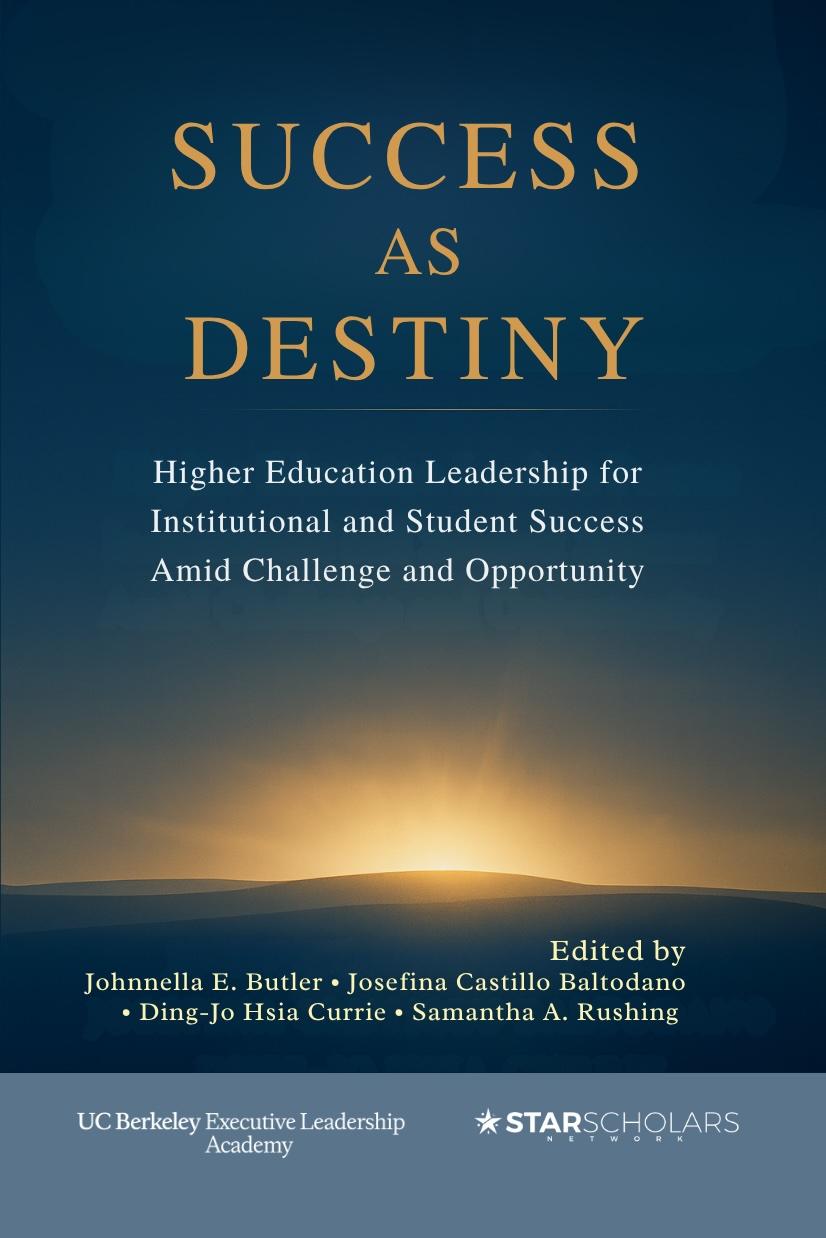
Success as Destiny explores how institutional leaders at every level can strengthen structures, processes, and approaches to advance both institutional and student success during moments of profound challenge and opportunity. Drawing on the expertise of distinguished faculty of the Executive Leadership Academy (ELA) at the University of California, Berkeley, this volume illuminates leadership practices rooted in collaboration, integrated decision-making, and servant leadership. Covering essential areas such as shared governance, legal issues, AI, enrollment, student affairs, data-informed practice, financial leadership, and strategic planning, the book offers actionable insights for current and future leaders. This is the second volume in ELA’s leadership trilogy. It stands as both a practical guide and a deeply reflective exploration of what it means to lead with purpose, integrity, and vision in higher education today.
Editors Johnnella E. Butler, Ed.D. Former Provost and Vice President for Academic Affairs, Spelman College | Atlanta, Georgia and former Associate Dean, The Graduate School, University of Washington | Seattle, Washington
Josefina Castillo Baltodano, J.D. Founder and Executive Director Emerita, Executive Leadership Academy, University of California, Berkeley | Berkeley, California and former President, Marian University | Fond du Lac, Wisconsin
Ding-Jo H. Currie, Ph.D. Distinguished Faculty and Director, Leadership Institute for Tomorrow, California State University, Fullerton | Fullerton, California and former Chancellor, Coast Community College District | Costa Mesa, California
Samantha A. Rushing Associate Director and Executive Assistant to the Advisory Board, Executive Leadership Academy, and former Program Administrator, Berkeley Global Executive Education, University of California, Berkeley | Berkeley, California
Table of Contents
Introduction .................. xix
1. Leadership Power Across Cultures ........................................ 1 Ding-Jo H. Currie
2. Leadership Modeling: A Personal Approach to Identity Development ....................... 17 David C. Wilson
3. From Successful Candidate to Transformational Leader ............. 30 Shirley Robinson Pippins
4. Presidential Leadership: Communicating Across Constituencies to Achieve Institutional and Student Success ............................... 40 Janet L. Holmgren
5. Utilizing Data to Inform the Presidency .................................. 49 Richard Yao
6. Faculty Governance and Academic Freedom ............................. 69 George R. Blumenthal
7. Legal Issues Facing Higher Education Amid Public Skepticism ........................ 81 Joseph I. Castro
8. Demystifying the AI Magic: Navigating Opportunities and Challenges of Artificial Intelligence in Higher Education ............. 94 Andrew W. Reddie
9. Student Affairs and Reimagining the University Student Experience ................... 104 Kent L. Willis and Barbara D. Holmes
10. The Enrollment Management Challenge .......... 117 Olufemi Ogundele
11. University Business and Finance .............. 133 Sarah C. Latham
12. Strategic Planning in Our Challenging Environment ................. 144 Johnnella E. Butler and Tarshia L. Stanley
