
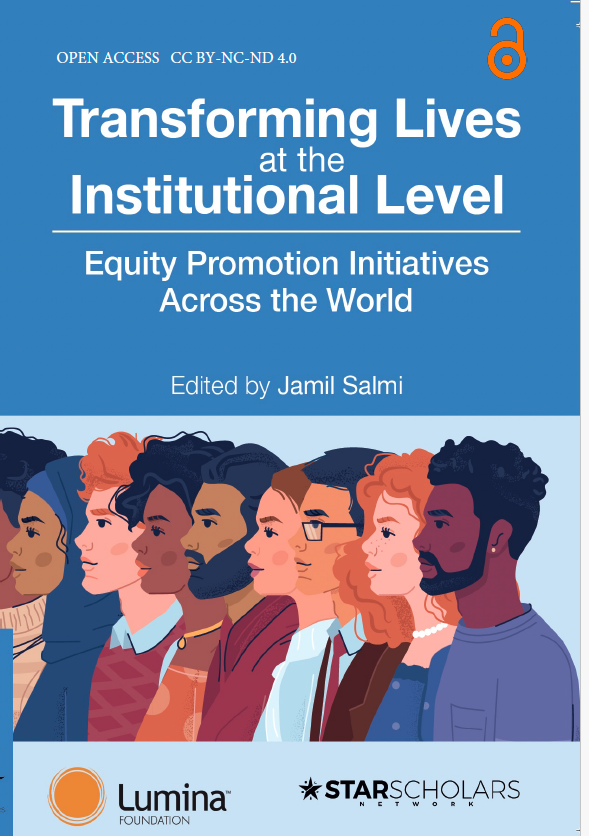
Transforming Lives at the Institutional Level: Equity Promotion Initiatives Across the World
STAR SCHOLARS PRESS
Publication date :
June 30, 2023
Synopsis
Transforming Lives at the Institutional Level explores innovative higher education initiatives from around the world aimed at enhancing access and success for underrepresented and marginalized groups. Through 31 case studies spanning seven global regions, this volume offers invaluable insights and lessons learned to inform equity promotion policies and practices.
OPEN ACCESS BOOK | CC BY-NC-ND
Open access editions of this book can be accessed here.
The open access edition of this book is freely available to readers worldwide and may be accessed, downloaded, and shared without charge through the publisher’s website and scholarly discovery platforms.
Praise for this book
Transforming Lives at the Institutional Level: Equity Promotion Initiatives Across the World, edited by Jamil Salmi is a timely and important resource providing insights into innovative policies and practices as well as barriers inhibiting access to and equity in higher education. Professor Ly Tran, Deakin University, Australia
***
What a fantastic collection of case studies from around the world! The book is so timely, given the increased focus on the transformative role of higher education, in the light of current geo-political events and increasing precarity of higher education’s mission, influenced too narrowly by the economic benefit perspective. The book is a must read. Aneta Hayes, Keele University, UK
****
At a time when too many countries are backsliding from the principles of democracy, including human rights protections for ordinary citizens–which at their very core demand access to educational opportunity–this book could not be more timely. But how do we correct course? This book provides some answers. Bernhard Streitwieser, George Washington University, USA
The event marked the official launch of Transforming Lives: Equity and Access for All Learners in Higher Education. Edited by Dr. Jamil Salmi, the book compiles proven approaches to reach underserved groups with case studies and practical solutions from over 20 countries.
“There is so much talent that goes to waste because millions of young people do not get the same opportunities to access and to be successful,” said editor Dr. Jamil Salmi, a Research Fellow at the Center for International Higher Education (CIHE) at Boston College.
From scholarship initiatives in Ethiopia to refugee support programs in Germany to curriculum decolonization efforts in Scotland and programs to support rural students in China and Australia the book highlights diverse solutions making a difference:
“I hope you’ll be able to glean at least one, if not many, more ideas so we can create a just and equitable post-secondary system,” said Dr. Courtney Brown, Vice President of Impact and Planning at the Lumina Foundation.
Key insights include combining financial and non-monetary policies, capturing intersectionalities, focusing on transitions beyond graduation, collecting better data, and aligning institutional and national approaches. Success factors across initiatives included dedicated leadership, pilot testing, and respecting diverse definitions of success.
“The equity interventions are sustainable when they are embedded in an institutional strategy and benefit from the support of all university stakeholders,” said Dr. Andrée Sursock, Senior Advisor to the European University Association.
“Leadership buy-in is a critical aspect that many people are facing,” added Dr. Renato Pedrosa, Institute of Advanced Studies, University of São Paulo.
Dr. Nidhi S. Sabharwal, Centre for Policy Research in Higher Education, share that “in India, specifically students from the socially disadvantaged groups are offered a relaxation of age and scores at admission…for increasing their access to higher education.”
Dr. Gerry Postiglione, The University of Hong Kong, observed that “the onset of massification in the emerging economies of Eastern Asia…has definitely improved opportunities from students, both men and women, from rural, minority, disabled groups, and particularly low income households.”
Participants included leaders from Australia, Canada, China, Colombia, Egypt, Ghana, India, Indonesia, Kenya, Malaysia, Nepal, Philippines, South Africa, Taiwan, Thailand, United Kingdom, United States.
Downloads
Copyright
Copyright (c) 2023 2023
