
Update Search
Categories
Series
Date
Update Search
Categories
Series
Date
1 - 6 of 6 items
Sort By
Publisher : STAR SCHOLARS PRESS
Published : June 30, 2026
Order Print Copies | Amazon | Hardcover | eBook | Google Books
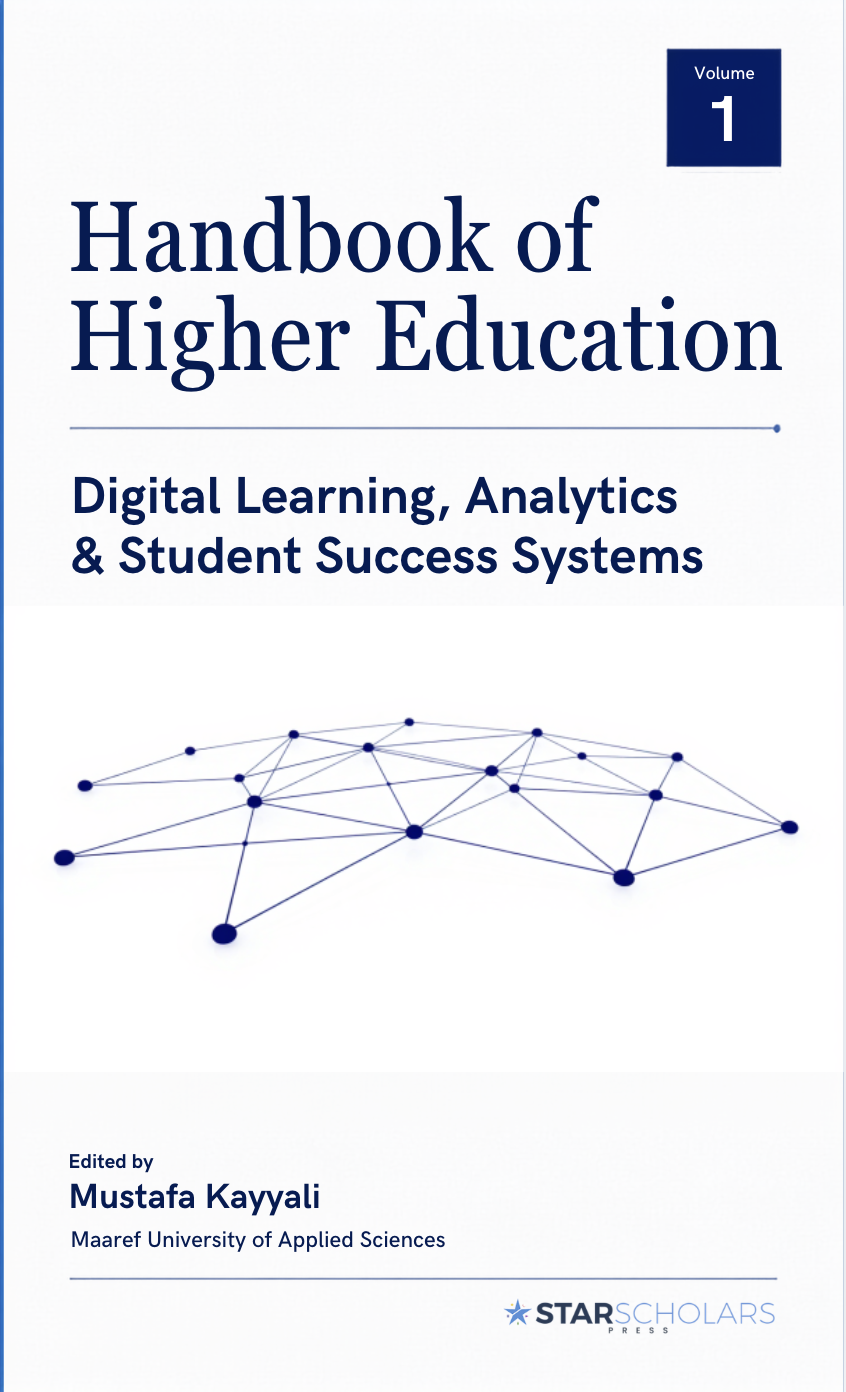
This volume examines the intersection of digital learning, learning analytics, and student success systems in contemporary higher education. Nine chapters written by scholars and practitioners from multiple geographic contexts analyze how artificial intelligence, institutional automation, faculty role transformation, and inclusive access technologies reshape higher education practice and outcomes. The volume combines theoretical frameworks with case evidence from national systems, disciplinary fields, and individual institutions. Core themes include the tension between digitalization and equity, the evolution of immersive and hybrid learning models, the role of data-informed decision-making in institutional performance, and the imperative to design digital transformations that serve all students, not only the advantaged. Intended for researchers, institutional leaders, faculty, graduate students, and policymakers, the volume argues that higher education can become simultaneously more efficient and more humane through thoughtful implementation and critical attention to context.
Publisher : STAR SCHOLARS PRESS
Published : August 9, 2026
Order your copies: Print Hardcover | ebook | Amazon | Google Books | Other Distributors
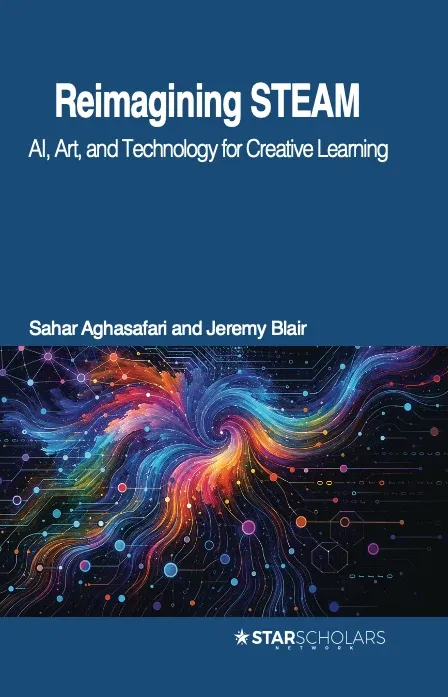
Reimagining STEAM: AI, Art, and Technology for Creative Learning examines the evolving intersections of artificial intelligence, art, technology, and interdisciplinary learning within contemporary STEAM education. Bringing together theoretical perspectives, empirical research, classroom practices, and critical inquiry, the volume explores how emerging technologies and arts-based approaches can support creativity, human agency, interdisciplinary thinking, and innovative pedagogy. Across diverse educational contexts, the chapters address human–AI interaction, visual metaphor, science communication, storytelling, media arts, sustainability, game design, creative identity, and AI-integrated art education. The volume also considers the ethical, cultural, and pedagogical implications of emerging technologies, emphasizing the importance of human-centered and reflective approaches to technological integration. Collectively, the contributions position the arts as central to STEAM education and offer educators, researchers, and practitioners perspectives and practices for developing creative, inclusive, and future-oriented learning environments.
Table of Contents
Introduction
Reimagining STEAM through AI, Art, and Technology Sahar Aghasafari & Jeremy Blair
Section I: Foundations and Theoretical Perspectives
Conceptual frameworks, pedagogy, human–AI interaction, and theoretical grounding
Chapter 1
Empowering Human Agency in Transdisciplinary STEAM through Artificial Intelligence Guey-Meei Yang
Chapter 2
Human–Machine Interplay: Visual Metaphor in STEAM Pedagogy Hsiao-Ping Chen & Guey-Meei Yang
Section II: Interdisciplinary Learning, Science Communication, and Applied STEAM Practices
Empirical research, interdisciplinary projects, storytelling, design-based learning, and science communication
Chapter 3
Structuring Science Through Story: Visual and Animated Narratives of Protein Folding in Undergraduate STEAM Research Sahar Aghasafari, Li Cai, Mark Malloy, Sara Luis, Earl Jasper Gerona & Sergio González-Eulogio
Chapter 4
Designing Tomorrow: Empowering Youth to Build Sustainable Futures through Storytelling, Media Arts, and Minecraft Sahar Aghasafari & Mark Malloy
Section III: Creativity, Identity, and Classroom Innovation
Creative pedagogy, identity, classroom experimentation, reflective practice, and AI in art education
Chapter 5
Resonant Pedagogies: Craft, Care, and Creative Risk in STEAM Classrooms Krystian K. Ramlogan
Chapter 6
(Re)Playing Self: Autoethnographic Game Design in the Art Classroom Jeremy Blair
Chapter 7
Art Meets AI: Opportunities and Challenges in the Art Classroom Jeremy Blair
Section IV: Global and Critical Futures in STEAM
Global perspectives, ethics, speculative futures, critical inquiry, and emerging directions in AI-integrated education
Chapter 8
Global Perspectives on AI-Driven STEAM Pedagogy Ambika Hanchate
Chapter 9
Imagining Futures: Art, Algorithms, and the Weight of Inherited Worlds Jeremy Blair & Sahar Aghasafari
Conclusion
Future Directions for AI, Art, and Technology in STEAM Education Sahar Aghasafari & Jeremy Blair
Publisher : STAR SCHOLARS PRESS
Published : May 13, 2024
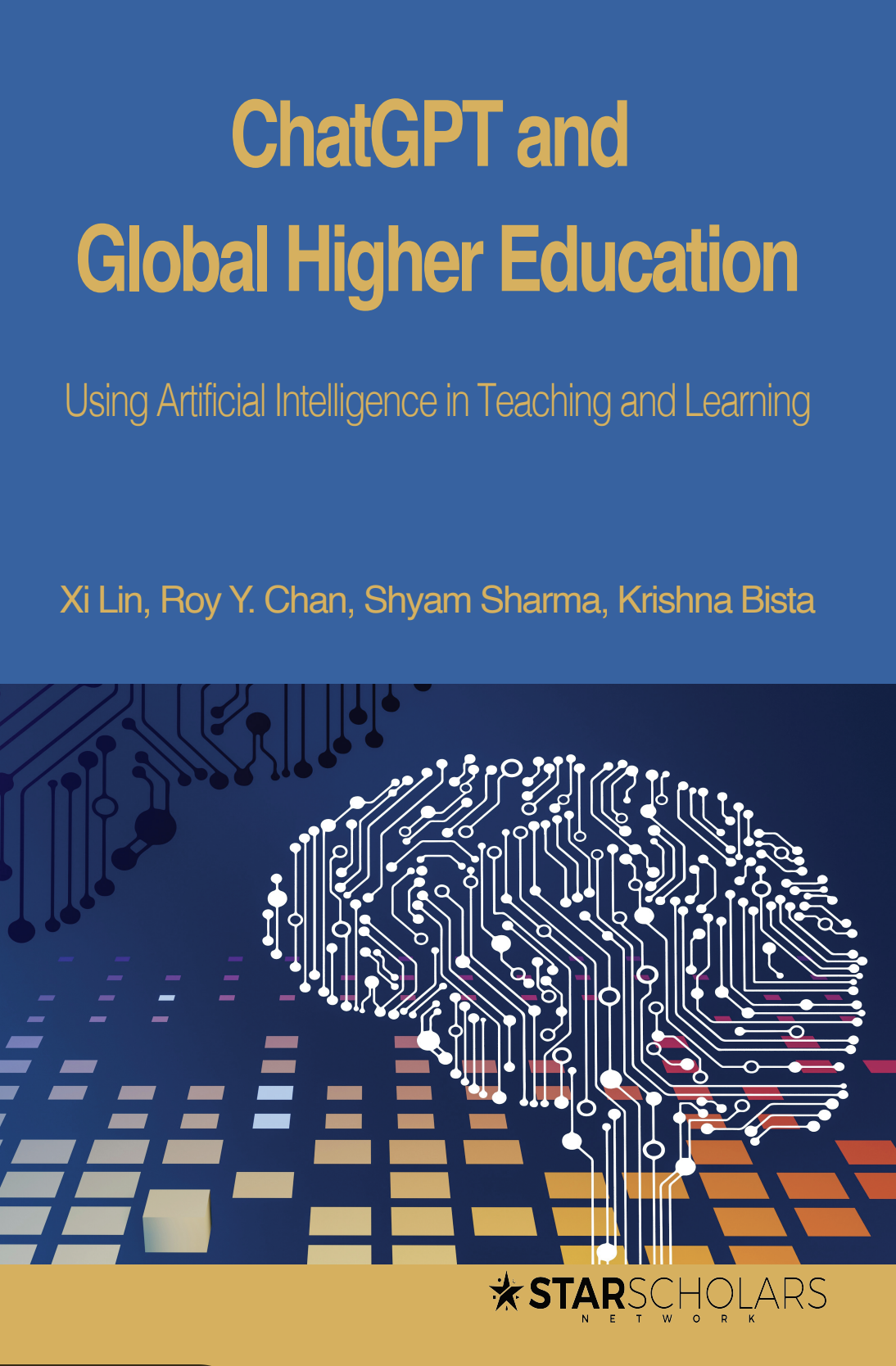
The rise of artificial intelligence (AI) tools based on advanced language models, such as ChatGPT and Bard, is transforming industries and professions worldwide, and higher education is no exception. ChatGPT, an AI-powered chatbot developed by OpenAI, has created a substantial amount of conversation and controversy across academia regarding what generative AI means for teaching and learning in the classroom. There is plenty of speculation not only about how those innovations will affect the academic profession but also what unique opportunities and challenges they present to global higher education. In this book, authors delve into the impact of AI and ChatGPT on higher education leadership and management, examining potential opportunities and challenges that this innovative technology presents to teaching, research, program, and policy.
The primary purpose of this volume is to provide a comprehensive, research-driven analysis of AI chatbots’ roles in shaping institutions of higher education around the world. By exploring the transformative potential of ChatGPT in academic settings, this timely book aims to bridge the gap between technological innovation and its practical applications. In the long run, we anticipate that this volume will provide valuable insights and guidance for teacher-scholars, university administrators, and policymakers on leveraging this cutting-edge technology effectively and responsibly.
Edited By Xi Lin, Roy. Y Chan, Shyam Sharma, Krishna Bista
OPEN ACCESS BOOK Creative Commons License | CC BY-NC-ND Open access editions of this book can be accessed here This book is published as an open-access publication by STAR Scholars Press. The digital edition of this book is freely available to readers worldwide and may be accessed, downloaded, and shared without charge through the publisher’s website and scholarly discovery platforms.
Order hard copies | Open Access Book (free)
Table of Contents
Prologue Keeping the Human (Educator) in the Loop Matthew Salzano
Chapter 1
The Impact of Artificial Intelligence (AI) on Global Higher Education: Opportunities and Challenges of Using ChatGPT and Generative AI Xi Lin, Roy Y. Chan, and Shyam Sharma
UNIT 1
The Use of ChatGPT and AI in Global Higher Education: A Historical View of Current Innovations
Chapter 2 Considering the History of Technologies in Education, the Distinctiveness of AI Apps, and the Future of Educational Systems Kenneth J. Luterbach
Chapter 3 The Influence of ChatGPT on Student Learning Outcomes in Higher Education: A Meta-Analysis of the Initial Empirical Literature Yankun He and Leslie Cordie
Chapter 4 The Evolution of Technology in Education and the Emerging Role of Generative AI Abdulrahman Alsharif
Chapter 5 ChatGPT as a Pedagogical Tool for Decolonizing Curriculum Bhavika Sicka
UNIT 2
Effective Practices and Standards of ChatGPT Use: Lessons Learned and Recommendations for Colleges and Universities
Chapter 6 Transforming STEM Education: Leveraging ChatGPT for Enhanced Learning in Psychology and Neuroscience Lingfei Luan, Xi Lin, Yan Dai, Laura Allen, and Shanhua Hu
Chapter 7 Hearing Students’ Voices: Access, Use Patterns, and Attitudes toward Generative AI Technologies among Chinese Students Ling Angela Xia, Olivia Yiqun Sun, and Charlie Reis
Chapter 8 Using ChatGPT to Improve Access, Inclusion, and Equity in and Through English-Medium Instruction in Higher Education Thatcher A. Spero
Chapter 9 A Comparative Study of ChatGPT and Seq2Seq Chatbot for Effective Student Advising Suha Khalil Assayed, Manar Alkhatib, and Khaled Shaalan
UNIT 3
Policy Implications and Ethical Considerations: Assessment and Accountability in Higher Education
Chapter 10 Generative Creations, Code, and Data: How Intellectual Property Rights over Ownership, Use, and Image Apply to Higher Education Jeffrey C. Sun
Chapter 11 ChatGPT and Research Ethics Lisa M. Rubin
Chapter 12 ChatGPT on Student Learning Outcomes in Higher Education: A Meta-Analysis of Early Studies Bo Zhang
Chapter 13 Rethinking Assessment and Feedback: Adapting Evaluation Methods for the Age of Artificial Intelligence Allen Farina
Chapter 14 Artificial Intelligence in Undergraduate Assignments: An Exploration of the Effectiveness and Ethics of ChatGPT in Academic Work Luke Parker, Christopher W. Carter, Alice Karakas, A. Jane Loper, and Ahmad Sokkar
UNIT 4
Current Issues and Future Concerns about Teaching and Learning
Chapter 15 Communities of Practice and Preservice Teachers in the Rise of the Artificial Intelligence Era: ChatGPT as a Method of Inquiry and Reflection Gabriela Mocanu
Chapter 16 Unlocking the Promise of AI: Exploring the Crucial Role of Faculty Members’ Growth Mindset, Self-Efficacy, and University AI Policies: A Study at Vietnam National University, Hanoi Kim Manh Tuan, Pham Van Thuan, Duong Thi Hoang Yen, and Nguyen Phuong Huyen
Chapter 17 Creating Context-Specific Critical Incidents with ChatGPT for Effective Soft Skill Training Stephan Ruppert
Chapter 18 Applications of ChatGPT in Work-Based Learning Programs: Opportunities, Challenges, and Ethical Considerations Hon Jie Teo
Publisher : STAR SCHOLARS PRESS
Published : September 4, 2025
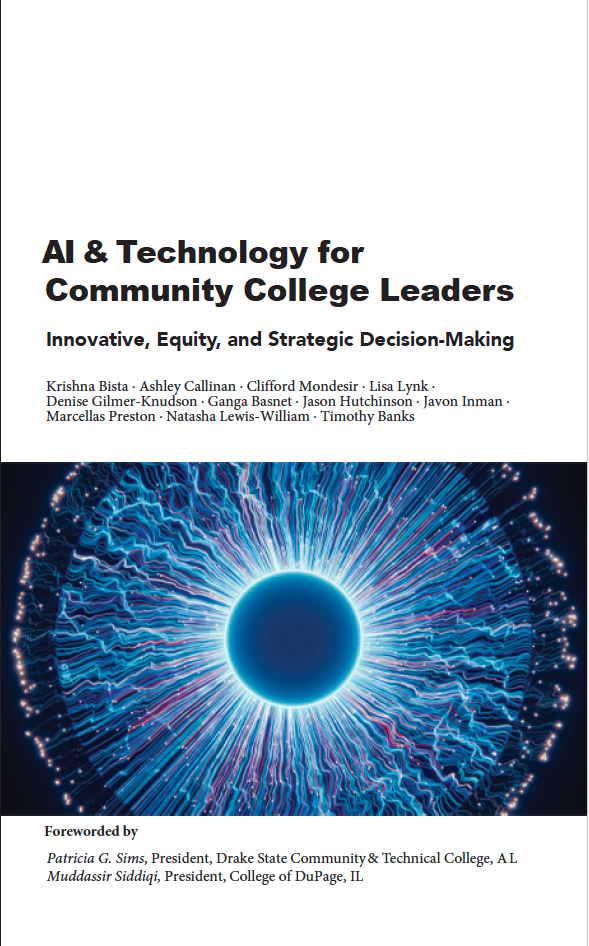
This book offers a practical and research-informed foundation for future community college leaders navigating the evolving digital landscape. Centered on the integration of educational technology into institutional planning, pedagogy, student success, and leadership, the book guides readers in critically evaluating digital tools, designing inclusive solutions, and anticipating emerging trends such as generative AI, cybersecurity, and equity-driven innovation. Blending theory, case studies, and reflective practice, this book equips doctoral students and practitioners with the skills needed to lead transformation in community colleges through ethical and strategic use of technology.
Order your hardcopies
"This book is a vital resource for community college leaders, offering practical strategies to navigate technological change while prioritizing equitable student success. Its concise, actionable insights make it essential for shaping inclusive and innovative educational environments."
— Lance D. Bowen, PhD, Dean, School of Science, Technology & Education, Anne Arundel Community College, Maryland
"A timely and transformative contribution, this book illuminates how community colleges can embrace digital innovation while staying true to their mission of access and equity. It is both practical and visionary, offering strategies that leaders, faculty, and staff can immediately apply to strengthen student success in a rapidly evolving landscape."
— Roshelle Lemon-Howard, EdD, MSN, RN, Assistant Professor & Coordinator, Practical Nursing Certificate Program, Baltimore City Community College
"This book provides an authentic look into the challenges and opportunities within community colleges. It highlights innovative practices that empower faculty and future educators, making it an invaluable guide for those committed to student success and educational equity."
— Melenese Sivells, EdD, Professor of Education, Northampton Community College
"This book powerfully demonstrates how community college leaders can harness AI to drive innovation while keeping equity at the center of decision-making. It is an essential guide for faculty and program directors preparing students—and institutions—for the future of higher education." — Huong Nguyen, EdD, Program Director, Montgomery College
“As a community college administrator, I found this book an invaluable guide that bridges innovation with access, showing how AI can be leveraged to enhance equity, efficiency, and student achievement.”
— Lesley Shotts, EdD, Dean of Institutional Effectiveness, Grants, and Research / Title III Administrator / Accreditation Liaison, Drake State Community & Technical College

Publisher : STAR SCHOLARS PRESS
Published : September 1, 2021
Global Higher Education During COVID-19: Policy, Society, and Technology explores the impacts of the novel coronavirus (COVID-19) for global mobility in the field of international higher education. Specifically, this book responds to the growing need for new insights and perspectives to improve higher education policy and practice in the era of COVID-19. The sub-theme that runs through this book concerns the changing roles and responsibilities of international education leaders and the demand to rethink comprehensive internationalization post-2020. Topics in this book include international students' experience, study abroad, branch campus, mental health, enrollment, and graduate education.
Editors: Joshua S. McKeown, Krishna Bista, and Roy Y. Chan
Order your copy: Paperback | eBook
Reviews
Dr. KS Adeyemo, Senior Lecturer, University of Pretoria, South Africa
Global Higher Education During COVID-19: Policy, Society, and Technology is a highly recommended resource for higher education institution policymakers and educators around the globe. Not only does this book provide invaluable insights from higher education institution policymakers, educators, and students during the COVID-19 pandemic, but it also offers useful suggestions on dealing with possible challenges and seeking opportunities in future higher education .
Dr. Misty So-Sum Wai-Cook, Centre for English Language Studies, National University of Singapore
It’s a timely book reporting the most recent responses of international higher education across the world during the Covid-19 pandemic. Besides providing the theoretical contributions, the book also offers practical implications for stakeholders, including policymakers, education managers and practitioners, international students, and parents.
Dr. Hiep Pham, Director, Center for Research and Practice on Education, Phu Xuan University, Vietnam
Global Higher Education During COVID-19: Policy, Society, and Technology is timely and relevant providing a critically engaged reflective account of geographically diverse higher education institutions’ response and practice during the COVID-19 pandemic. This book illuminates some of the current impediments to higher education internationalization within the context of COVID-19 and provides insights into shared learning experiences that address new challenges to internationalization imposed by the pandemic. A must-read for international higher education specialists, practitioners, scholars, and researchers.
Dr. Tasmeera Singh, Advisor, International Office, University of KwaZulu-Natal, South Africa
A worldwide phenomenon: Strategies and inspiration to address the challenges and opportunities for the new normal in the field of global higher education. I cannot recommend it highly enough.
Dr. Daisy Kee Mui Hung, Associate Professor, Universiti Sains Malaysia, Malaysia
The movement of people across borders furthered the spread of Covid-19. This inevitably impacted international higher education, which although not reducible to student mobility is its primary form. Global Higher Education during COVID-19: Policy, Society, and Technology is, therefore, a timely edited collection that begins to unpack the multifaceted impact the pandemic has had on higher education worldwide. It adds to the growing conversation on reimagining higher education. The collection will be valuable to current and future scholars of higher education, offering an important snapshot of policy and practice during the pandemic.
Dr. Will Brehm, Lecturer of Education and International Development, UCL Institute of Education, UK
With the COVID-19 crisis having upended higher education around the world, this timely book provides a deep and much-needed analysis of the roles and responsibilities of universities going forward. It sheds light not only on the shared challenges countries have faced, but also reveals how the impact of the pandemic has varied in important ways across countries.
Dr. Rajika Bhandari, Author/Advisor, STAR Scholar Network, USA
This book presents a comprehensive and rigorous worldwide account of Covid-19 impact, challenges and new opportunities. It stands out as a ground-breaking valuable companion for all those involved in the future of internationalization in higher education.
Dr. Elena de Prada Creo, Vice Dean for International Affairs, Facultad de CC. Empresariales y Turismo, Spain
Hard copies are available able on Amazon.com
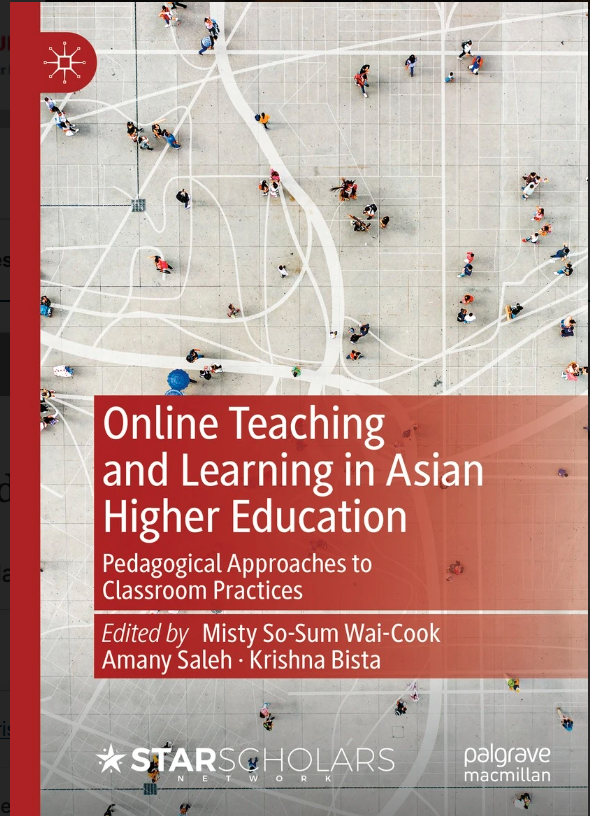
Publisher : STAR SCHOLARS PRESS
Published : October 11, 2023
In a world where online education has become paramount, this book is a comprehensive guide to navigating the challenges and innovations encountered in Asian higher education during the COVID-19 pandemic. It delves into various aspects of online teaching and learning, including curriculum design, student engagement, assessment strategies, and the use of technology in the classroom.
Editors: Misty So-Sum Wai-Cook, Amany Saleh, Krishna Bista
Table of contents
About this book
Keywords
Reviews
Editors and Affiliations
About the editors
