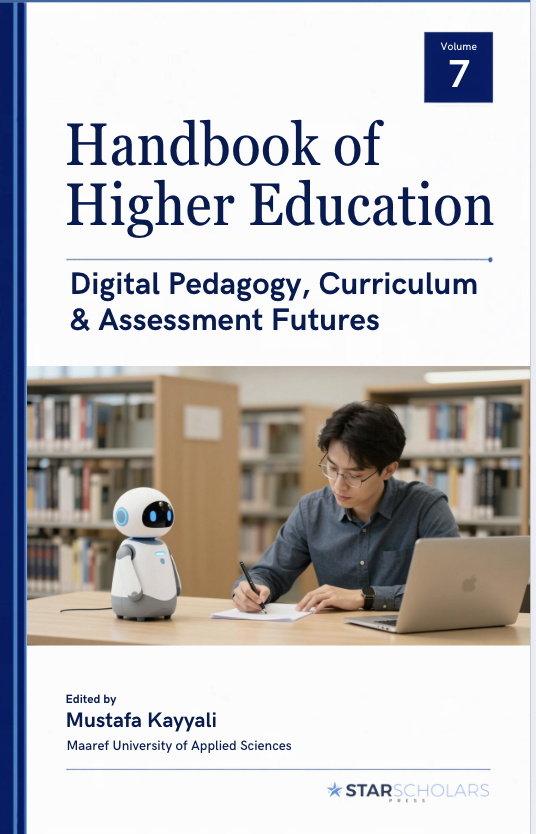
This volume investigates the future of digital pedagogy, curriculum, assessment, and quality assurance across rapidly changing higher education systems. Twelve chapters address decentralized and hybrid learning, personalized and adaptive education, smart institution roadmaps, teaching efficiency, fragmented quality frameworks, accreditation and research excellence, Faculty 4.0, the faculty role as a human safeguard in AI-rich environments, hospitality employability, and assessment integrity. The contributors draw on international contexts to examine how institutional design, faculty capability, technology, and governance influence learning outcomes and public trust. The volume gives particular attention to the tension between flexibility and coherence, innovation and quality, automation and human judgment. It also considers how graduate attributes and assessment practices must evolve as artificial intelligence becomes embedded in learning and professional work. Intended for researchers, curriculum designers, faculty, institutional leaders, quality assurance professionals, graduate students, and policymakers, the volume argues that credible digital futures require pedagogical purpose, ethical assessment, inclusive access, and sustained investment in human expertise.
Editor: Mustafa Kayyali, Maaref University of Applied Sciences
How to cite this book: Kayyali, M. (Ed.). (2026). Handbook of higher education: Vol. 7 - digital pedagogy, curriculum & assessment futures. Star Scholars Press.
ISBN: 979-8-89524-103-5 (hardcover) ISBN: 979-8-89524-104-2 (ebook)
Order Hardcover Book | Download eBook (Open Access) | Available on Amazon , Barnes & Noble , Google Books, and other vendors
This volume examines how digital learning, analytics, and student success systems are quietly rewriting the inner grammar of higher education. It looks beyond platforms as tools and asks what happens when learning becomes traceable, adaptive, and continuously interpreted through data. The chapters explore online and hybrid learning, predictive analytics, advising systems, student engagement, retention, and the ethical use of educational data. At its core, the volume asks a difficult question: can institutions use digital intelligence to support students without reducing them to dashboards? The answer, unsurprisingly, is complex, hopeful, and sometimes unsettling.
This volume examines the intersection of digital learning, learning analytics, and student success systems in contemporary higher education. Nine chapters written by scholars and practitioners from multiple geographic contexts analyze how artificial intelligence, institutional automation, faculty role transformation, and inclusive access technologies reshape higher education practice and outcomes. The volume combines theoretical frameworks with case evidence from national systems, disciplinary fields, and individual institutions. Core themes include the tension between digitalization and equity, the evolution of immersive and hybrid learning models, the role of data-informed decision-making in institutional performance, and the imperative to design digital transformations that serve all students, not only the advantaged. Intended for researchers, institutional leaders, faculty, graduate students, and policymakers, the volume argues that higher education can become simultaneously more efficient and more humane through thoughtful implementation and critical attention to context.
Editor: Dr. Mustafa Kayyali, Maaref University of Applied Sciences
ISBN: 979-8-89524-075-5 (hardcover) ISBN: 979-8-89524-076-2 (digital/PDF)
Order Print Copies | Amazon | Hardcover | eBook (open access) | Google Books
List of Contributors
Priti Dadasaheb Mane, Saibalaji International Institute of Management Sciences, India Sarika Rajabhau Khandekar, Dr. D.Y. Patil Vidyapeeth, Global Business School and Research Centre, India Buhle Stella Nhlumayo, University of South Africa, South Africa Offia Tugwell Owo, Ignatius Ajuru University of Education, Nigeria James Chibuzor Asobie, Ignatius Ajuru University of Education, Nigeria Kusum Lata, D.G.C. Gurugram, India Massane Chafik, INSEEC - OMNES Education Group; University of Bordeaux, France Alaamri Nahid, Cadi Ayyad University, Morocco Le Thi Bich Loan, Posts and Telecommunications Institute of Technology, Vietnam Finita Glory Roy, OP Jindal Global University, India Friggita Johnson, Claflin University, United States Agnieszka Wójcik-Czerniawska, SGH Warsaw School of Economics, Poland Zbigniew Grzymała, SGH Warsaw School of Economics, Poland Lisa Chinyoka, Bindura University of Science Education, Zimbabwe Tendai Towo, Bindura University of Science Education, Zimbabwe Knowledge Jonasi, National University of Science and Technology, Zimbabwe Maxwell Kunambura, Bindura University of Science Education, Zimbabwe
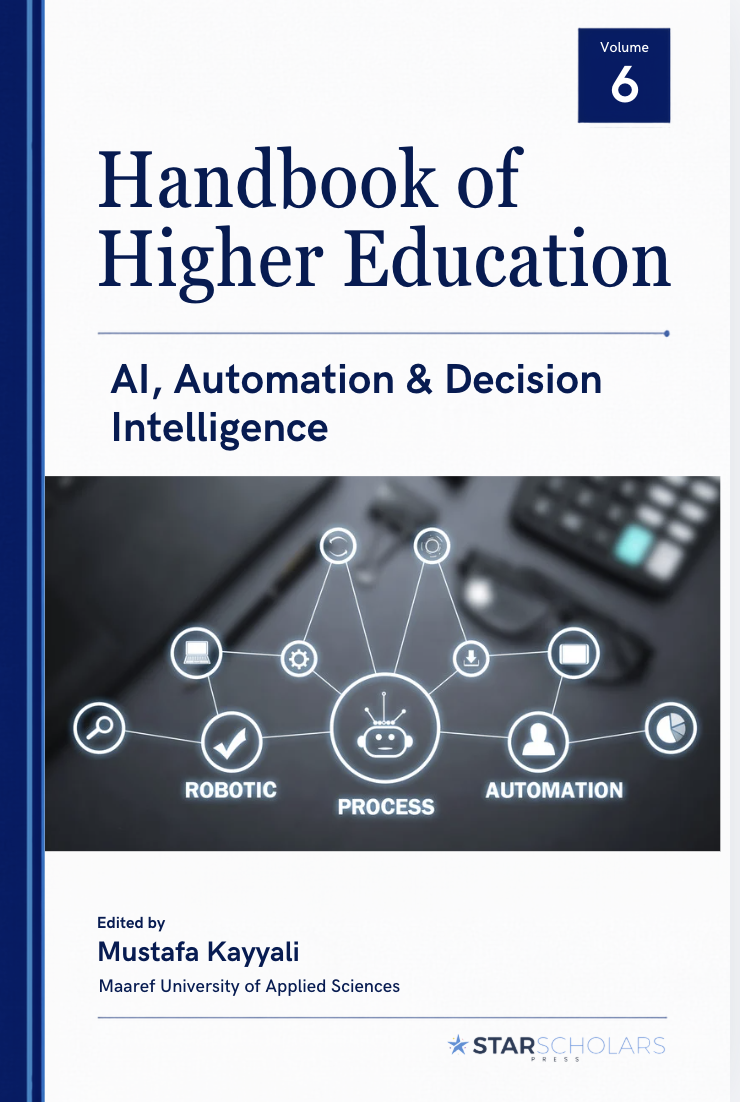
This volume examines how artificial intelligence, automation, blockchain, and data-informed governance are changing decision-making in higher education. Ten chapters move from academic credentials and learning records to educator roles in open and distance learning, university digital transformation strategies, faculty capability development, smart teaching governance, AI-supported teaching tools, disability inclusion, and digital-age policy. Contributions from multiple national and institutional contexts combine conceptual analysis, case comparison, technical architectures, and practical institutional recommendations. A central concern is how universities can use intelligent systems to improve efficiency, trust, access, and responsiveness while preserving professional judgment, transparency, privacy, and human responsibility. The volume treats faculty development and inclusion as essential parts of technological transformation rather than secondary implementation issues. Intended for researchers, university leaders, faculty developers, quality assurance professionals, policymakers, IT teams, and graduate students, it argues that decision intelligence becomes educationally valuable only when automation is governed ethically, interpreted critically, and aligned with institutional learning.
Editor: Mustafa Kayyali, Maaref University of Applied Sciences
How to cite this book: Kayyali, M. (Ed.). (2026). Handbook of higher education: Vol. 6 - AI, automation & decision intelligence. Star Scholars Press.
ISBN: 979-8-89524-101-1 (hardcover) ISBN: 979-8-89524-102-8 (ebook)
Order Hardcover Book | Download eBook (Open Access) | Available on Amazon , Barnes & Noble , Google Books, and other vendors
List of Contributors Rahul K. Patel, Illinois Institute of Technology, USA Smrity Dey, JIS College of Engineering, India Rakhi Dey, JIS College of Engineering, India Zahra Sadat Roozafzai, University of Applied Science and Technology, Iran Akiva La Geer-Jeremiah, Central China Normal University, China Sherihan Radi, Brandenburg University of Technology, Germany Vijaya Supriya Samnoel, REVA University, India Pedzisai Goronga, University of Zimbabwe, Zimbabwe Morine Matongo, University of Zimbabwe, Zimbabwe Memory Deredzai, University of Zimbabwe, Zimbabwe Parveen Sharma, Lovely Professional University, India Yogesh Kumar Sharma, Lovely Professional University, India Mustafa Kayyali, Maaref University of Applied Sciences, Syria Restu Januarty Hamid, Bosowa University, Indonesia Monika Vishwakarma, University of Lucknow, India Maria Arjie T. Domingo, Bulacan Agricultural State College, Philippines Carimo Hassam Rassal, University of Algarve / University of Évora, Portugal Priti Dadasaheb Mane, Saibalaji International Institute of Management Sciences, India Sarika Rajabhau Khandekar, D.Y. Patil Vidyapeeth, Global Business School and Research Centre, India